
A short history
From scientific experiment to living art.
1829
The accidental discovery
British botanist Dr. Nathaniel Bagshaw Ward noticed a fern sprouting inside a sealed glass jar he was using to study moth chrysalises. The plant thrived with no watering at all.
1830s
The Wardian case
Ward's sealed glass cases let living plants survive months-long sea voyages, changing how plants travelled around the world.
1850s
Plants go global
Tropical plants from distant lands reached Europe, sparking a wave of interest in exotic plants and indoor gardening.
Late 1800s
The Victorian trend
Terrariums became elegant centrepieces in Victorian homes, admired as decoration, education and a symbol of exploration.
1900s
A modern evolution
From scientific tool to design object, terrariums found their way into homes, offices and classrooms worldwide.
Today
A modern living art
A blend of science, nature and art, loved for its beauty and sustainability. At Terra World, we add one more layer: your story.
The Science
A tiny ecosystem that looks after itself.
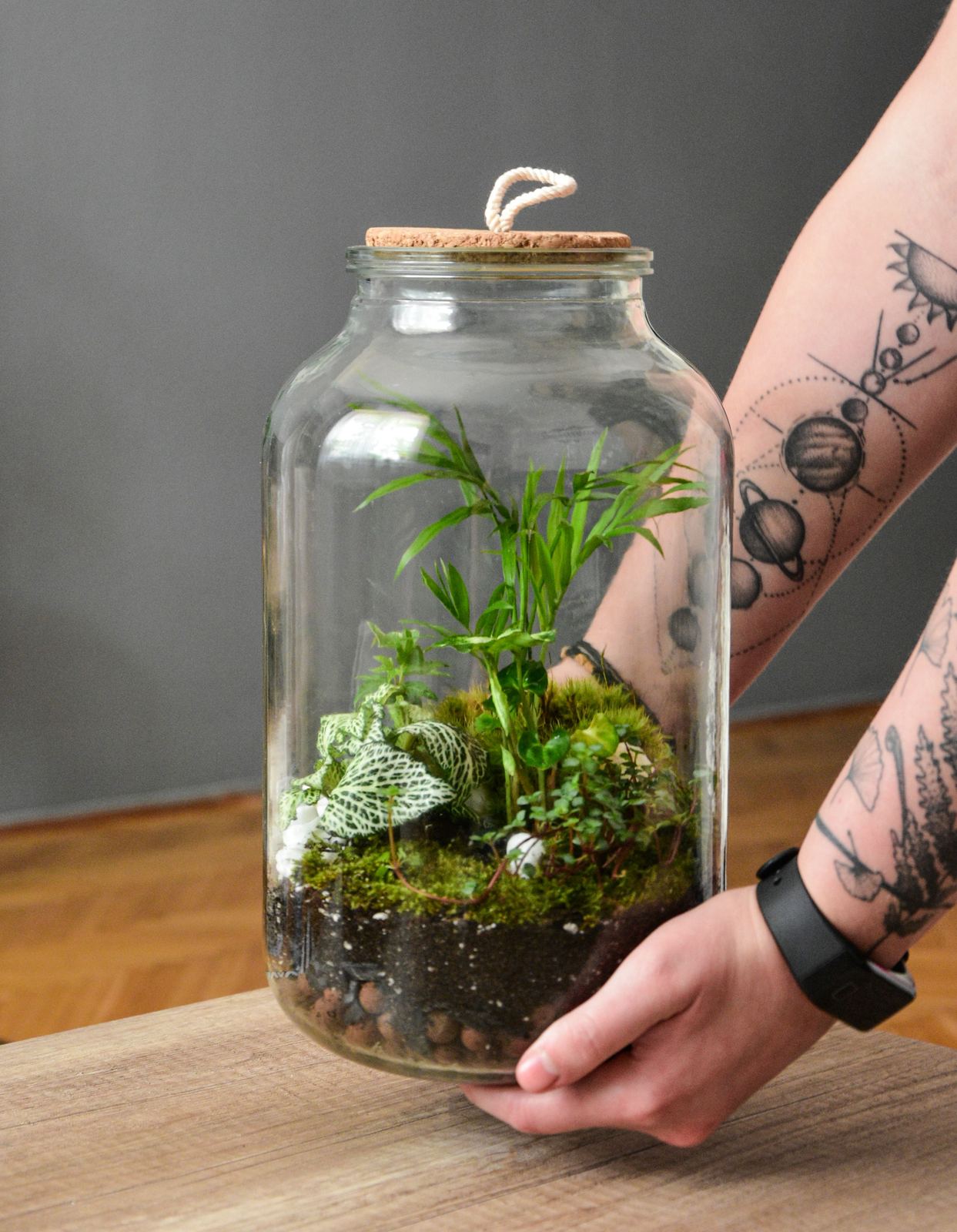
Inside a closed terrarium, the same cycles that run a forest run in miniature.
Light
Drives photosynthesis. Plants turn light, water and CO₂ into food.
Water cycle
Water evaporates, condenses on the glass and returns to the soil as droplets.
Gas exchange
Plants take in carbon dioxide and release oxygen, keeping the air balanced.
Microclimate
The glass holds steady humidity and temperature, ideal for moss and ferns.
Nutrient cycle
Microorganisms break down fallen leaves, returning nutrients to the soil.
The layers
Drainage stones, charcoal, substrate, then moss and plants, each with a job.
Why closed?
We only make closed terrariums.
A sealed glass world is the truest living sculpture: it waters itself, holds its own climate and keeps changing slowly over time.
- A self-sustaining water cycle inside the glass
- Almost no watering: weeks or even months at a time
- Steady humidity, ideal for moss, ferns and tropical plants
- Very little care, so it suits busy homes and offices
Care Guide
Simple care, lasting beauty.
Right light
Bright, indirect light, a metre or two from a window. Direct sun turns the glass into a greenhouse and can scorch moss.
Read the glass
Light mist that clears during the day means it is balanced. No mist for several days means it is too dry. Fog all day means it is too wet.
Watering
It can go weeks or even months without water. When it is too dry, give a few light sprays from a mister. Never pour.
Too wet or mouldy?
Take the lid off for a few hours to let it breathe, then close it again. Pick out any mouldy or yellowing leaves.
For every terrarium
- Keep at room temperature, 18–28°C
- Away from heaters, AC vents and direct sun
- Use filtered or rain water, or tap water left out overnight
- Wipe the outside of the glass with a soft, dry cloth
- Trim plants with clean scissors if they touch the glass
- Keep it on a stable surface and enjoy the changes over time
About grow lights
Some photos show a grow light for display. Grow lights are not included with our terrariums. A bright window works well.
Not sure about yours? Send us a photo on WhatsApp and we will help.